|
One day in 1986 my fellow Roland showed up and told me, that he accidentially met a farmer, who was a retiree already and who had piled up the remains of his old cars in the orchard behind his house. Roland came in contact with the farmer, because of the old 1962 Opel Rekord Caravan he drove at that time and which we had restored and rebuilt with a lot of work.
|
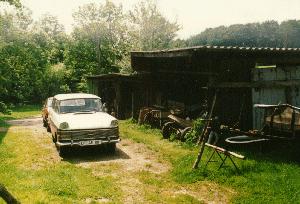
Our arrival at the farm. To the right the first row
of shacks that hid really phantastic treasures.
|
The farmer said "I had one of these too" and noted at some point, that the remains from it might "lay around behind the house somewhere". Rolands Caravan had a few missing pieces - particularly some elements from the signs and chrome parts were incomplete. The farmer offered Roland to have a look by himself, to see if he could locate something useful.
A couple of days later we drove over there - and more or less accidentially I had my camera with me and was very sorry afterwards that I only had the half of a film left over and no spare. I could have filled that as well. So I can only use the few pictures I took back then.
When we arrived on the - pretty remotely located - farm estate we immediately noted the numerous shacks and low storages around the house. There the farmer has stored all his old tractors, trailers, plows and even a complete, however small harvester. I spotted at least four VW Beetles between the farming gear dated between 1957 to 1968, which were at least from the outside view in reasonable shape. Nobody abandones a car for no reason and puts it into a storage. But the farmer wasn't willing to explain a lot at first. He was pretty quiet and didn't say a lot at all, particularly when he noted, that I was going to make pictures.
"Why'd you want to depicture that crap ?" he asked. He later mentioned, that he had some trouble with the local authorities in the past, when they wanted him to remove his 'Private Crapyard' and threaded him with a lawsuit. Fortunately the officials were too busy with other, more important stuff and forgot about him after some time and the things stayed where they had been for years already.
"Nay - I'd never liked to throw anything away." he confessed. "Sure, I left one car out on the old junkyard over there. Might have been dugged under the junk."
Today there are large trees growing there, but I could vaguely recall that I had passed the junkyard during a school excursion in around 1968. The junkyard has been closed in the early seventies and covered with gravel and earth. Back then (in 1968) I have counted at least ten car wrecks, which still might be lying under the ground. But that is just an aside.
|
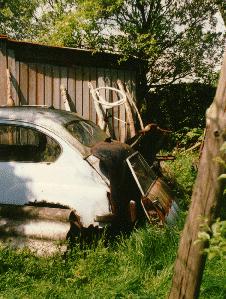
First findings: behind a Fiat 600 from
around 1960 was the entire steering section from an
Opel Olympia of 1960, to the right a codriver door
from the very same Opel model. Rusted but complete.
|
At least the old farmer got a lot more relaxed during our visit when he realized that we were in fact just a little bit crazy after old cars and curious about that old stuff. More even, since I could recall the old junkyard. So we started to wander around in that orchard and tried to identify the most of the objects within a timeline and sorting them for individual cars. That was a bit tricky, since the tides of time had treated some of the parts rather unfriendly and they were decayed, washed out and sometimes corroded beyond recognition.
Mainly we were after parts for the Rekord Olympia and the garden owner guided us behind a small barn, in which a rare 1947 Hanomag Single-Cylinder Traktor resided. It slept there for maybe 20 or 25 years. Behind that barn we located the near-empty hull from a white Fiat 600 from the 1958 to 1962 series - hard to estimate the exact year. But at least it still had the "suicide doors", which opened at the front of the body at the A-pillar. My father had the same model from 1961 to 1964, however the stronger 700cc version.
There we located the first Opel parts: a steering column, including the gear shifting and with a reasonably preserved white Bakelite steering wheel. Behind the Fiat there was a co-driver door standing upright. Pretty much rusted, but with perfect side window, door lock, chrome linings and a somewhat useable inner side panel. Even though the side panel base is only cardboard mocked-up with synthetic leather it had survided the numerous changing seasons in a pretty good shape.
"What happened to the car anyway ?" I asked out of curiousity. I shouldn't have asked.
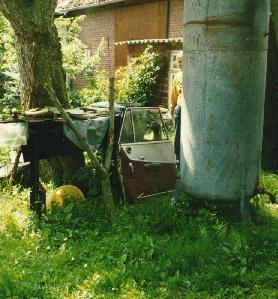
"I cut it in pieces." First I thought he was only joking. "Yeah, exactly. At first I'd tried to hack it apart with a hatchet, but that didn't work very well. Then I took it apart with a saw. You know: I used the car for transporting a water barrel for the cows outside in the fields. Took off the roof, put the 400-litres barrel in the rear and could drive up and down from the farm to the pastures. Worked fine for a couple of month, then the suspension was gone and the frame broke."
|
Somehow a second door showed up.
again the co-driver side. In a similar condition.
To the right the already mentioned 400-litres barrel.
|
"And what about the remains ?"
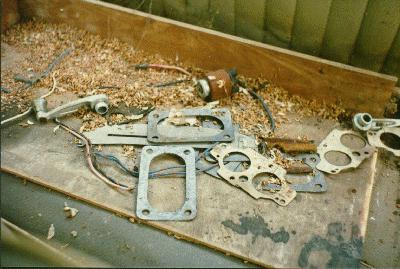
"I made a power saw from the drive train and engine ... the other crap must be somewhere around here."
If I hadn't seen it with my own eyes I hadn't believed it. The "Selfmade Power Saw" appeared a bit later in our view. He simply openend the differential gear and attached a 15" circular sawblade to the one output shaft and welded the other one to block it. The saw blade was attached with a very obscure looking "fixing" - and thick welder spots. The rest of the chassis he'd just "torched away", so he said.
Unbelieveable. But now he owned a 3-speed power saw with 55 hp. The saw table was constructed from thick oak planks - without any protection against the rotating blade or an emergency stop. Nothing at all.
"Pretty good for cutting thicker pieces of wood." the old chap commented plainly. He still had all fingers, which did surprised me quite a bit.
A very remarkable landmark in the garden was a NSU-Fiat 1100 Neckar, built in around 1957, to which I come back later again. There were also a lot hoods, roofs and single fenders and a few doors.
"I chopped down a lot cars in the sixties. The most of the hoods and roofs have been used as covers for flower and crop beds or to put them over machins for example."
A very pragmatic approach using up old cars. The lot of the hoods and roofs came from old Opels of the fifties. He seemed to have had a faible for that brand anyway.
"Well, well, they were pretty ridig beasts." Obviously not rigid enough to withstand his saws, hatchet and gas torch, as it seemed.
|
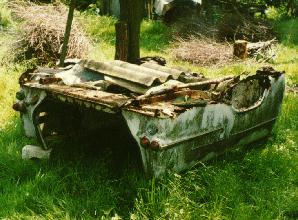
We were looking exactly after that:
The rear end of a Caravan.
We had prefered one in better condition
and more complete. But anyway ...
|
Not at all.
The upside-down resting rear end segment of an Olympia Caravan told its own story. The roof pillars had been chopped off with an axe and a gas torch had assisted in separating the front from the accompanying rear half.
"The front end is under the covers over there. I made the power saw from it."
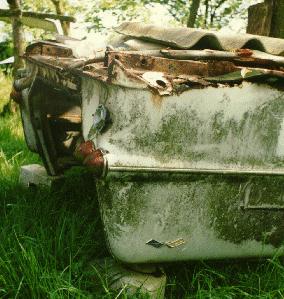
Alright, so now all of that were the left-over debris from the decapticated water waggon. As if that would matter much. Whatever: wether the cows had appreciated it or not is unknown. Pretty romantic with a rustic charme of its own there was this rear end. With all the chrome linings, rear lights, filler cap and the long-searched (and not yet found) flag emblems. On both sides ! My gods - where had we been already to get a pair of those. All these flea-markets, all those dealers. We had wounded feet from running around on swap meets ... and here they are. 'still in the original mounting position on the deceased vehicle'. A bit of collected dirt and moss and slightly matted, but fully intact and almost unscratched. Even the chrome side linings were still useable, apart from some minor scratches and dents and apart from the fact that really all of the rusted fixing screws immediately broke away after half a turn. Who cared ?
|
... the long-wanted emblems are there !
|
Even the round and pointy rear lights - commonly called "Teeny Titties" - were useable after a good cleaning job. They were rear light / brake light (inner) and flasher (outer) and both in all-red. These were even in a better shape than those we had mounted on Rolands Caravan at that time. Only the rear additional "cats eyes" reflectors were gone. The car didn't have a reverse gear light - not until 1963, when the last model-year of the 'Panoramic Window' Rekord P2 got orange flashers. Then came the Rekord 'A' with a modernized body without panoramic windows and without these little tailfins, different, squarish look and square combination rear-lights.
But that is a totally different story.
As you can see from the pictures: if you reached a certain age your bed is not made of roses. It is a 1 1/2 standard brick instead for the final resting place. Why someone put one of those asbestos-cement sheets over the fragment will forever be unanswered. Rumours say that the rear end had been used to house a couple of rabbit and most likely the sheet was placed there to cover the hole where the fuel tank has been to prevent the long-ears from fleeting. But that is - as said - an unconfirmed rumour. History refuses to give a clear answer, just a probability and the old farmer also didn't know it exactly anymore..
|
|
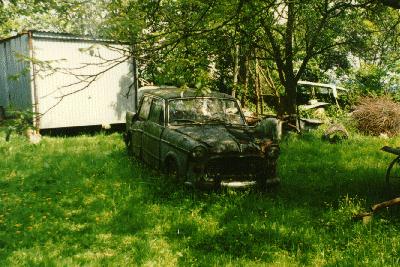
Exhausted technique among the lifely green. A panorama.
|
On a first look around in the garden the viewers shocked (or impressed) eyes were directed towards the morbid diorama, formed by the decaying 1100 Fiat and the bauhaus-cubistic sheet-metal garage. The very fragile Italian with a german passport almost made it into the 'Great Wide Open', just to die down between the trees and from then on slowly fell apart. The garage - in the meantime - houses another one of the old man's treasures: the further above mentioned 1947 Hanomag tractor.
Now, we are all forced to set out priorities in our life one time or another, which is to be kept and which is to be sacrificed or which is doomed to just corrode elsewhere. In this case it seemed that the teutonic Hanomag won against the italian Fiat. From the time it had been placed there (in around 1968 - the owner could not recall when) its body was bound to corrode. Those Torinian vehicles never had been really rust-resistant anyway. And still aren't today - according to public hearsay.
Other vehicle components wander through strange reincarnations, due to their rust-resistance: the chopped-off Caravan roof for instance can be seen in the picture in the right background. Steelbars in the pillars lift it up and this way it could act as a cover over decades for another machine stored outside.
|
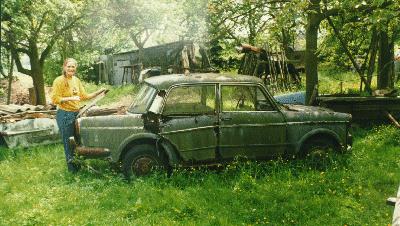
Quod erat demonstrandum: Italians are 'open to the public'.
At least after they stood around outside for longer.
|
Now - the spirit is flying high ... and the substance is low down.
A closer examination of the Oldie-Fiat (collectors and friends of the brand will surely cry out loud) unveils a lot of decay. Rolands wife - at that time - Tina demonstrates in the neighboring picture, that the trunk lid is far away from even elementary requirements on luggage protection. A certain 'Openness' can be stated, but it is not in the sense of the engineers, when the luggage gets stolen or wet. What luggage anyway ? The cars trunk bottom was also largely gone and either load would have dropped onto the street completely. The fate had played evil buggers with the german-italian co-production anyway. After an accident, which damaged the front left side it had been parked in the garden. Rain, sun, rust and intruding moisture appeared to have broken its backbone. The stability of - for example - the roof pillars would be more than questionable. A false impression however. The rear door 'only' lost the outer skin and the C-pillar into the roof ... now, the thing won't drive elsewhere anyway. At least not with own engine power.
In fact our archeological attempts (and telling the tales of them to others) led to the fact that someone was willing to free the little Fiat from its exile. Of course not for a restauration - you don't go with a deep-frozen chicken to a vet for re-animation either - but to recover useable parts from it. The retired farmer left him the choice between all or nothing and the enthusiast opted for 'all'. The Fiat was merely cooperative, since it decided not to fall apart right there, when they lifted it with a tractors fork-lift onto a trailer. It saved it for the moment when it had been loaded off again. Geez. What a heap of crap.
|
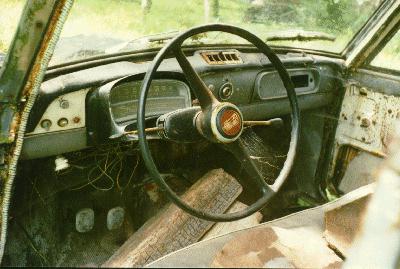
The simple charme of the Fifties and a scent of mould.
The signet on the steering wheel identifies the car as NSU-FIAT
with Heilbronn als place of birth instead of Torino.
Made in Italy - assembled in Germany.
|
Now, you can't relocate old trees.
In the meantime the small, intimate private junkyard is history and long gone. After my informations the old farmer died at very old age and has been buried on a regular graveyard in an orderly grave .... but you never know with these people ... ! The new farm owner, a younger relative of the old farmer, had had no sense for 'that old junk'. Not even the powerful saw found mercy. The local junkdealer needed a lot of overtime work to get the area cleared and most of the stuff might have been reborn as part of the body of some VW Golf or Opel Astra. With the years the sensibility for environmental pollutions has grown and these kind of crapyards in orchards is no longer tolerated.
Except - probably - where the eyes of the officials are lesser sharp and the authorities are lesser all-present. Maybe somewhere in the bavarian forests in a remote village, maybe somewhere in Saxonia towards the borders to our eastern neighbors or somewhere in the northern marshlands someone might have hoarded his old vehicles in the garden and don't want to part from them.
I personally haven't found something similar again. And if I ever come across something like that I would take far more films with me and a better camera.
Someone out there with a hint ?
|
A very pleasant view on truth, illusions and hopes.
Life is transitoriness and nothing lasts forever.
|
|
|
